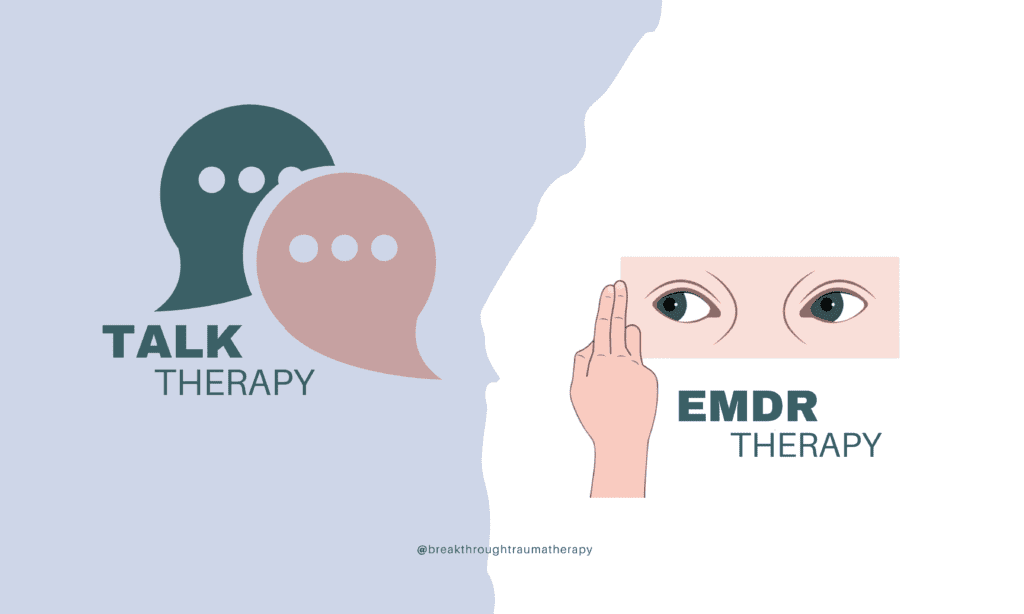
Psychotherapy is a vital part of mental well-being. With many options available, choosing a suitable therapy may be challenging. Top on the list of effective evidence-based mental health treatments are talk therapy and Eye Movement Desensitization and Reprocessing (EMDR) therapy. EMDR therapy is a quick and effective alternative, offering immediate relief. In contrast, talk therapy delves into the psychological roots of issues, examining causes, triggers, and behavioral patterns to enhance your understanding of your biases and develop healthy coping mechanisms.
Both EMDR and talk therapy provide much-needed relief in mood disorders encompassing anxiety, depression, and trauma. Choosing the appropriate intervention depends on your
situation. Here is a deep dive into both EMDR and traditional talk therapy to help you deliberate which one is ideal for your condition.
EMDR vs. Traditional Talk Therapy Definition
Traditional talk therapy is verbal communication with a certified therapist to establish a mental condition’s cause, stressors, and emotional, thought, and behavioral patterns. The therapist also
provides adaptive techniques that reduce symptom severity and help with emotional, thought, and behavioral regulation. Talk therapy focuses on helping you understand why you think, feel, and act the way you do and empowers you to develop healthy patterns.
On the other hand, EMDR therapy is an intervention that stimulates the brain to develop healthy emotional memories. The therapy improves mood disorder symptoms, emotional, thought, and behavioral regulation, and understanding of traumatic experiences. EMDR also enhances talk therapy outcomes by priming the brain to be more responsive to healthy coping strategies.
Variations in Mechanism of Action
Talk therapy relies on introspection. Understanding your mental health issues requires openness and honesty about your experiences and feelings. Your therapist guides the conversation as you reflect on your account of things. They use your information to curate techniques that enable you to identify negative coping mechanisms and triggers. The therapist also develops strategies that alter maladaptive emotional cycles, thoughts, and behavior.
In contrast, EMDR does not require a comprehensive understanding of the mental disorder, symptoms, or triggers. The therapy’s effect on the brain produces adaptive memories, making it easy to understand and regulate thoughts, emotions, and behavior. EMDR therapy uses two techniques: bilateral stimulation and focusing on the problematic memory.
Bilateral stimulation engages the two brain hemispheres by moving stimuli from left to right, ensuring seamless communication between nerve networks. Therapists use auditory stimulation by alternating rhythmic sounds from one ear to the next. Tactile stimulation involves tapping hands or knees to stimulate the mind, while visual stimulation entails guiding eye movements from left to right using a finger or an object.
You will focus on a problematic memory as the therapist performs bilateral stimulation. Both techniques boost memory processing, enabling the incorporation of isolated memory networks into healthy memory networks. Once processed, the memory becomes less distressing or vague and is easily integrated into long-term memory networks, leading to a calmer and more adaptive understanding.
Variations in The Science Behind EMDR and Traditional Talk Therapy
EMDR bases its evidence on the Adaptive Information Processing (AIP) model. The theory postulates traumatic or stressful experiences interfere with the functioning of the hippocampus,
the part of the brain responsible for developing short-term and long-term memories. The glitch results in the development of isolated memory fragments with faulty cues, which evoke unregulated emotional responses.
Bilateral stimulation and focusing on the problematic memory improves functioning in the hippocampus, boosting memory processing. The resulting memory is healthy, adaptive, and capable of incorporation into other healthy networks with correct cues.
Talk therapy focuses on cognitive and behavioral modification, which is possible by understanding the source of the mental problem, triggers, and maladaptive behavior. Comprehending a problem, its impact, and awareness of its triggers ease the chances of accepting the necessary changes. Therapists use meditation, mindfulness, thought rationalization, and more to regulate thoughts, emotions, and behavior.
Differences in Therapy Sessions
On average, traditional talk therapy typically involves 5 to 20 sessions, with each session lasting between 30 and 60 minutes. Sessions can occur weekly, bi-weekly, or monthly. The sessions
can be one-on-one, group setting, or a mixture of both. Your therapist determines a suitable structure based on your condition and expected outcomes.
EMDR therapy has 6 to 12 sessions. Most people do not need to complete all sessions because of the instantaneous results. The sessions last between 60 to 90 minutes.
EMDR vs. Traditional Talk Therapy Treatment Outcome
Traditional Talk Therapy
● Deepens your understanding of the source of your stress or trauma and your natural coping mechanism
● Reveals the destructive nature of your coping behavior
● Teaches you life-long techniques for identifying triggers, managing distressing symptoms, and regulating thoughts, emotions, and behavior.
● Encourages self-actualization
EMDR Therapy
● Reprocesses your memories, boosting thought and emotional regulations
● Frames your mind to be more receptive and responsive to cognitive and behavioral restructuring
● Reduces the intensity of the symptom manifestation
● Eases the process of piecing missing memory links in trauma-related situations.
Which Therapy is Best Between EMDR and Traditional Talk Therapy?
Both Talk Therapy and EMDR draw their foundations on proven research. They are effective in treating mood disorders. Nevertheless, there is no one-size-fits-all intervention in psychotherapy.
Therapists curate sessions on a case-by-case basis. The best therapy is the one that resolves your mental condition. Therapists choose interventions and techniques based on various parameters. Therefore, the strategy your therapist chooses is the best one for you.
Start Your Healing Journey Today
Your mental well-being is essential to your overall health. It is wise to seek the services of a certified therapist to help you develop mental strength and resilience. Dragging your feet on seeking help is harmful to your mental health. It produces maladaptive cognitive and behavioral patterns that are challenging to unlearn.
Seek professional help today. Therapists have the training, resources, and expertise to handle complex mood disorders. They will help you maneuver through the murky waters of mental
distress while providing support and accountability. You do not have to forebear with this problem. Your healing journey can begin right now.