
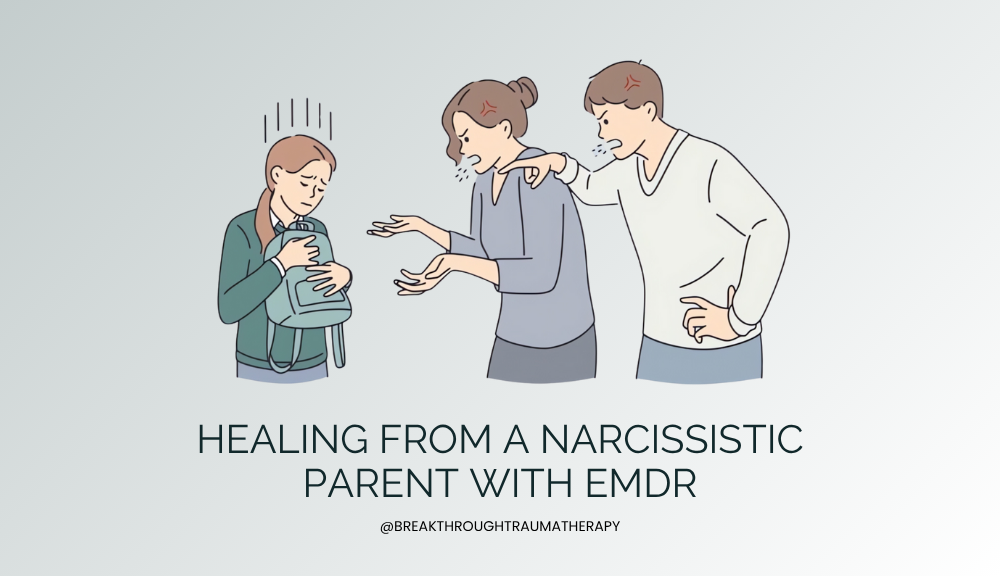
It is typical to hear people throw around the word narcissist to describe a self-absorbed person. However, narcissism is far worse than self-centeredness. Its impact can be deeply destructive,
leaving significant mental and emotional scars, especially when the behavior originates from a parent. In such parent-child relationships, the inherent power imbalance can make confronting
the parent challenging, often due to fear of negative repercussions. On the good side, Eye movement desensitization and reprocessing (EMDR) can help you undo the damage of living with a narcissistic parent.
Emotional Trauma from Living with a Narcissistic Parent
Experiencing narcissism from a parent is emotional abuse. It triggers lasting psychological distress that can persist in adulthood. How do narcissistic tendencies from caregivers cause trauma in children? Understanding narcissistic personality disorder symptoms and how they play out between a parent and child can shed light on trauma development.
Lack of Empathy
When a parent invalidates, dismisses, ignores, belittles, or even mocks a child’s emotions, it teaches the child that their feelings are insignificant. Children adapt to the trauma by feeling ashamed of their emotions, avoiding or suppressing their feelings, or becoming emotionally distant in relationships.
Grandiose Sense of Self-Importance
A narcissistic parent’s inflated ego drives them to mold their child into a mere reflection, erasing the child’s individuality in service of their self-image. It denies the child the freedom to explore their thoughts, feelings, or needs. Worse still, the child’s best effort could never measure up to the parent’s talents or achievements. Moreover, failure is met with criticism, rejection, and shame, eventually impacting your self-worth and value.
Exploitative Behavior
A parent’s manipulative and controlling behavior in the form of blackmailing, gaslighting, or ridicule produces immense anxiety in children. Emotional exploitation also pushes the child to become the parent’s emotional caretaker. On the other hand, financial exploitation in adulthood may evoke frustration, resentment, bitterness, and even depression.
Arrogance
Constant dismissal or invalidation of a child’s emotions, thoughts, and experiences by a narcissistic parent breeds low self-esteem, unhealthy dependence, and maladaptive coping. Humiliation and criticism can create immense pressure and anxiety around failure.
Entitlement
The entitlement in a narcissistic parent makes them believe their needs and desires are superior to those of their children. The parent disregards the child’s boundaries, preferences, and inputs, leaving the child feeling used, violated, and unimportant.
Envy
A narcissistic parent can jeopardize a child’s success because it threatens their accomplishments. The parent may sabotage the child’s success, withhold praise, create competition and rivalry with siblings, take all the credit, or withdraw emotional support and validation.
Demanding Excessive Admiration
Living with a parent with an insatiable need for validation is emotionally exhausting. It can intensify insecurities and anxiety in the child as their feelings and emotional needs get overshadowed by the parent.
How Does EMDR Help Children Overcome Trauma From Living With Narcissistic Parents?
EMDR is a psychotherapy that helps people process distressing emotional memories. The trauma of living with a narcissistic parent rewires the brain into survival mode. Part of this remodeling affects how the brain forms, retrieves, and reacts to memories surrounding your upbringing.
The therapy’s foundation stems from the Adaptive Information Processing (AIP) model, which explains how trauma affects emotional memory processing. Repeated exposure to stress interferes with the functioning of the hippocampus, the brain part responsible for forming long-term memory. The compromised hippocampus produces erroneous memory fragments and stores them as isolated memory networks. The lone memory networks interfere with your ability to process, understand, and resolve traumatic memories.
When retrieved in the prefrontal cortex, the isolated memory networks trigger an overwhelming emotional response. The prefrontal cortex also becomes hypersensitive to stressors due to prolonged trauma exposure. EMDR therapy facilitates the hippocampus’s ability to process and integrate fragmented trauma memories by correctly encoding and consolidating them within broader memory networks.
The change restores the distorted memory fragments, increasing your response to cognitive and behavioral-based therapies. EMDR therapy also helps you develop healthy, long-term memories and reduces the psychological and emotional impact of the traumatic memory.
What Techniques Does EMDR Therapy Use?
EMDR therapy uses two techniques–bilateral stimulation and focusing on a problematic memory.
Bilateral Stimulation
- Bilateral stimulation uses sensations to activate both sides of the brain. Therapists use three methods:x
- Visual stimulation – the therapist guides your eye movement from left to right using a hand or an object.
- Auditory techniques – the therapist uses rhythmic tones or taps alternatingly on both ears.
- Tactile stimulation – the therapist uses alternating taps on the hands or knees to excite the brain
Recalling A Traumatic Memory
You are supposed to focus on a traumatic memory while the therapist performs bilateral stimulation. At the end of the session, the two techniques initiate memory processing in the hippocampus. The brain then integrates the memory into a healthy memory network, reducing the impact of the associated distress.
How Does EMDR Therapy Occur?
EMDR therapy is a non-invasive intervention. There is no pocking, electric shock, or injections. The therapy does not require medication. Talk therapy is also not a necessity. You do not need to understand the basis of your trauma or its impact to experience relief.
The entire treatment has 6 to 12 sessions. Most patients report significant improvements after a few therapy sessions.
The Benefits of EMDR Therapy in Treating Trauma From Living With A Narcissistic Parent
- EMDR therapy helps you process emotional trauma from years of abuse by a narcissistic parent.
- The treatment improves your response to accompanying treatments.
- Therapy results are immediate. Patients experience better emotional regulation, thought rationalization, reduced hypersensitivity to triggers, and healthy memory formation.
- EMDR therapy also works with other psychotherapies like cognitive behavioral therapy (CBT).
- Therapy sessions are brief and effective.
Start Your Healing Journey Today
You have come a long way despite the burden of living with a narcissistic parent. The pain, shame, disdain, and inconveniences are overwhelming even for the most resilient minds. You do not have to bear with this emotional turmoil any longer. Begin your healing journey with a certified EMDR therapist today.
Contact Us